The foundation every business needs.
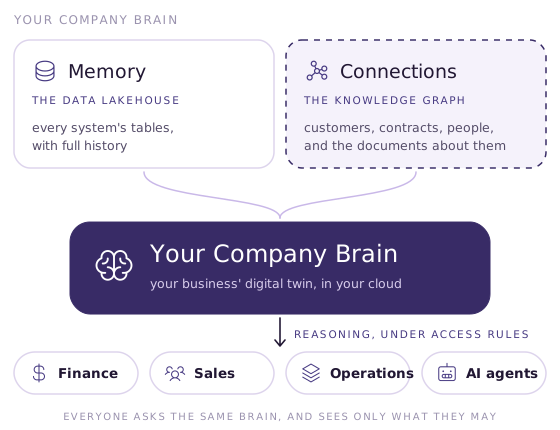
Data lakehouse, knowledge graph, your business' digital twin. Every source and user of data working from the same stable platform: finance, marketing, operations, customer service, IT and product connected and ready for AI. Tables in the lakehouse, documents and relationships in the knowledge graph, in your own Azure tenant, behind access rules.
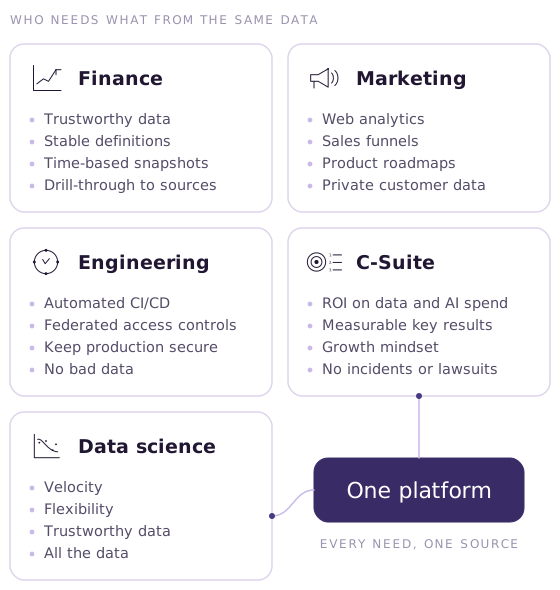
Three versions of the same metrics. Business and IT using different sources. Finance built their own database.
A mid-sized company runs on five to fifteen systems. Exports and custom macros still produce the same mistakes every month. Marketing and finance teams have given up, they have their own databases. The CEO doesn't have the metrics she's asked about for years. IT has a plan, but the hotfixes keep pushing the work back and we're still not ready for the AI pilot.
The contracts, manuals, tickets and emails that explain the numbers live somewhere else again: a shared drive, an inbox, a vendor portal. Nobody can say who can see what. Pointing an AI tool at this makes it worse: Gartner predicts that through 2026, organizations will abandon 60% of AI projects that lack AI-ready data.
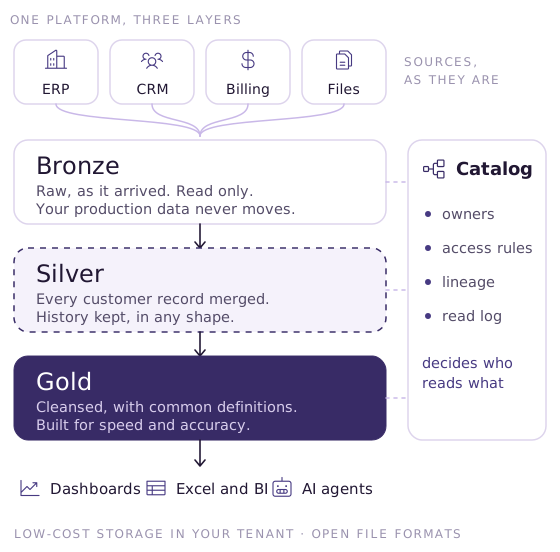
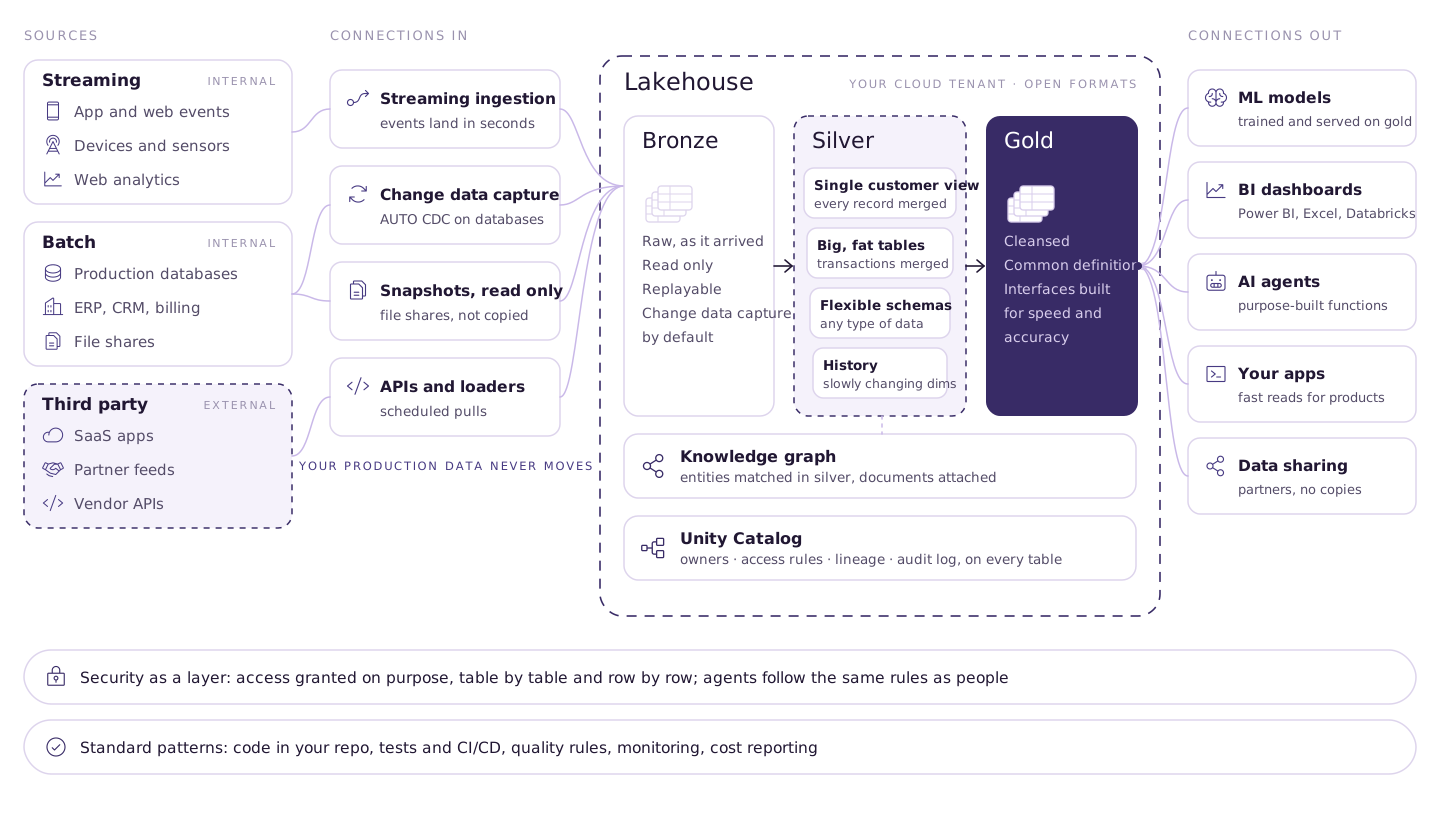
One platform, three layers, one definition per metric
Incoming Connections:
Bronze: Your production data never moves. We build change data capture by default. Databricks AUTO CDC handles databases. File shares are snapshotted, not copied. Read only.
Silver: Every customer record merged for a single view. Transaction records merged into big, fat tables. Flexible schemas for any type of data. Slowly changing dimensions capture state and history.
Gold: Data is cleansed. Common definitions are applied. Interfaces for consumers designed for speed and accuracy.
Outgoing Connections: ML models are trained and served by Gold. BI dashboards are displayed. AI Agents query purpose-built functions that ensure trustworthy answers.
This is the memory of your company brain. It is where the industry is going: 67% of organizations expect to run most of their analytics on a lakehouse within three years, up from 55% (Dremio, 563 IT decision-makers, 2025).
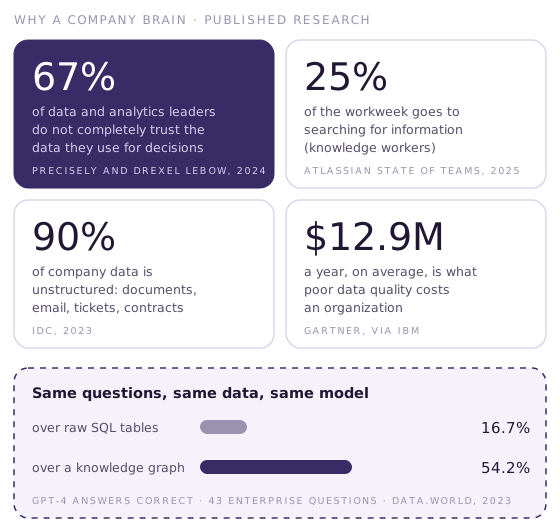
Why a company brain, and why now
Most companies do not trust their own numbers, and most of what they know is in documents no report can read.
With Your Company Brain, a lakehouse and a knowledge graph built by DataMind, the leadership meeting starts from one trustworthy number. Month-end reconciling becomes a scheduled job and the forecast is actionable. Every table has an owner, clear access rules, and a log of who read it and when. Every document is linked to the customer, contract or asset it defines. Everyone can query the same data, with their privileges, and customers' private data stays that way.
A Diagnostic measures where yours stand.
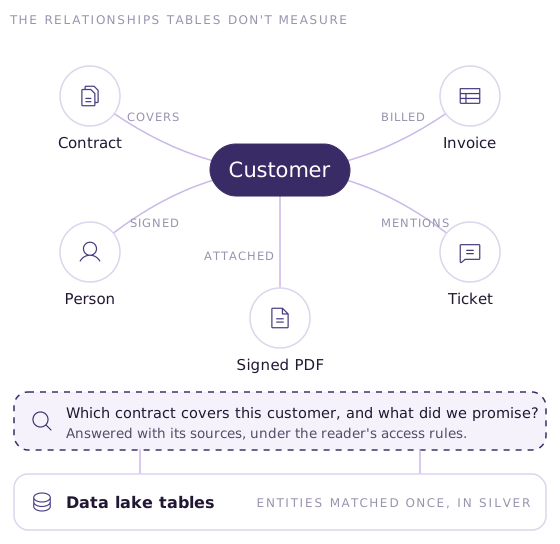
The relationships traditional databases don't measure
Tables answer "how many" and "how much." They are bad at "which contract covers this customer, who signed it, which tickets mention it, and what did we promise." That is a graph: customers, contracts, assets, people, documents, and the links between them.
We build it on top of the lake, from the same sources. Entities are matched once, in silver. Documents are indexed and attached to the entity they are about, so a contract sits next to its invoices and its support thread.
A person asks a question in plain words and gets the answer with its sources. The graph is what makes the answer right: in one benchmark, answers over a knowledge graph were three times as accurate as answers over the raw tables (data.world, 2023). An agent walks the same graph under the same access rules, so it answers only from what that user is allowed to read.
This is what makes it your company brain, a digital twin of the business: memory in the lakehouse, connections in the graph, and reasoning by the people and agents who use it. All accessible by humans, or by AI. You decide.
How the work runs
Map
It starts with the DataMind Diagnostic: sources, owners, the five contested numbers, and the documents that explain them.
Agree
We write one definition for each number with the people who use it.
Build
We load, clean, match entities, set the access rules, and publish tables and the first graph.
Hand over
Your team gets the platform, the catalog, a cost baseline, and a roadmap.
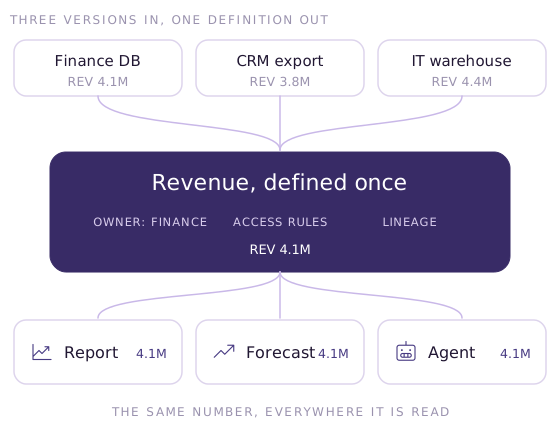
A working platform, not a report
If we walk away, you keep everything: the platform runs in your Azure subscription and your repo from day one.
A catalog with one definition per contested metric, the gold tables that match it, and owners, access rules, and lineage.
The graph: matched entities, their relationships, and the documents linked to them, with a search your people and your agents both use.
Pipelines in Spark and SQL, a cost baseline, and a roadmap for the next sources.
A working session on running and extending it, with us or without us.
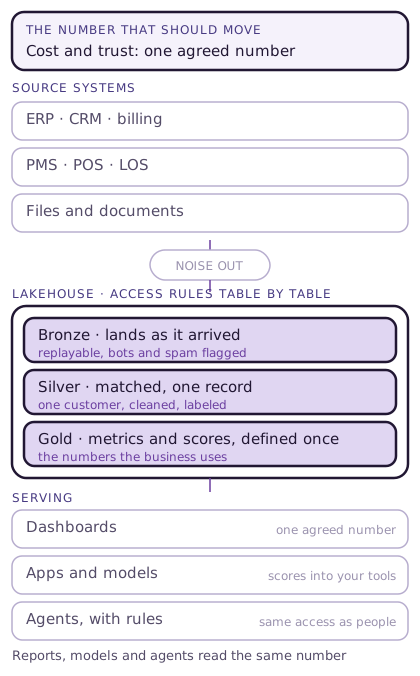
Where this sits in the system: it is the system
Sources: ERP, CRM, billing, your property or reservation system, and the files that explain them, landed as they are.
Platform: this page is the platform itself, your company brain. Bronze keeps what arrived, silver matches it, gold defines each number once, the graph holds the relationships and documents, and the catalog decides who reads what.
Value: one agreed number, month-end as a scheduled job, storage cost you can see. We name the number that should move in week one.
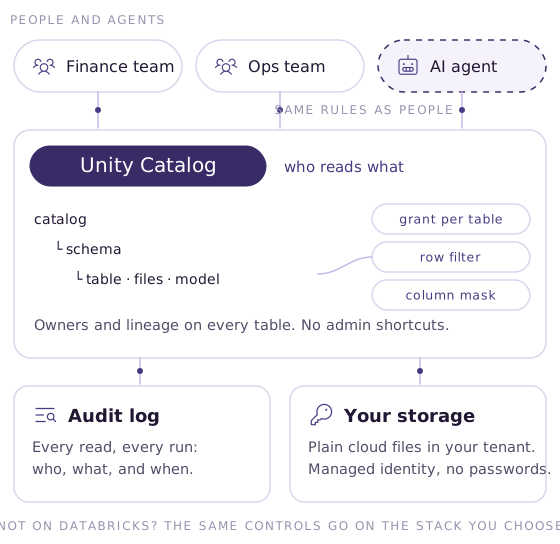
Access granted on purpose, table by table
Databricks has many layers of security control and a top-tier security architecture. Admins get no shortcuts: access is granted on purpose, table by table, and even row by row, logging every job and every query.
Your files stay on plain cloud storage in your tenant. Row filters and column masks hide what a reader should not see. Agents follow the same rules as people, including the Microsoft and Databricks agents you already license.
No passwords to leak between the platform and your storage: your cloud provider gives the platform its own identity. Not on Databricks? The same controls go on the stack you choose - the pattern is the same.
Bots and spam are flagged and cleansed in silver, so a metric never counts them and a model never learns from them. Sorting traffic in and out is its own discipline: Fraud, Bots & Spam.
Compared with the other ways
Do nothing
Another quarter of exports and arguments. Waiting is a real option. Ask what it costs.
Hire first
A good hire needs a platform to land on. We can give your team a jumpstart and help you develop them.
Developer plus AI
AI writes code fast. Algebra is the easy part. Shaping the data to answer the right questions needs DataMind.
Who builds it
Our principals are Databricks Certified Data Engineer Professionals. Twenty-five years turning data into products, twelve at Microsoft. The person on the call builds it.
At a national ed-tech safety provider, stood up a Databricks lakehouse and ML for 31,000 school districts, one platform for pipelines, data science and model serving. At Bing, feature pipelines at search scale.
Co-inventor on Microsoft patent US 10,839,149 B2. Built Microsoft AI products: PowerPoint Designer and Word Editor.
On the business side: twelve years at Microsoft, lead data scientist to the CSO and CFO. Senior data leader in telecom and ed-tech. MBA, Economics, Entrepreneurship and Technology. MS, Data Science.
We build it, with our network of experts: senior engineers, data scientists and security partners we have worked with for years, brought in when the work needs them.
References
Gartner, via IBM: poor data quality costs organizations an average of $12.9 million a year
Gartner, Lack of AI-Ready Data Puts AI Projects at Risk, February 26, 2025
Microsoft Learn, Use Azure managed identities in Unity Catalog to access storage
Microsoft Learn, Audit log system table reference (Azure Databricks)
Microsoft Learn, What is the medallion lakehouse architecture? (Azure Databricks)
Bring the number everyone argues about.
In a free discovery session we map where it comes from, which documents explain it, and what a first slice looks like. You leave with a plan, not a proposal. Want a fixed-scope first look before you commit? The DataMind Diagnostic maps your sources, your contested numbers, and what a company brain would cost, for a fixed fee.