Prove it fast. Keep what you build.
Is the idea worth building? We prove it on your data, then build and ship a first version in your cloud and your repo, scored on one number we agree on before the build. Fixed price, from $7,500.
Anyone can build it. Few can say if it should exist.
Do you have one idea, one budget, and a board, a lender, or a customer who wants to see it work first?
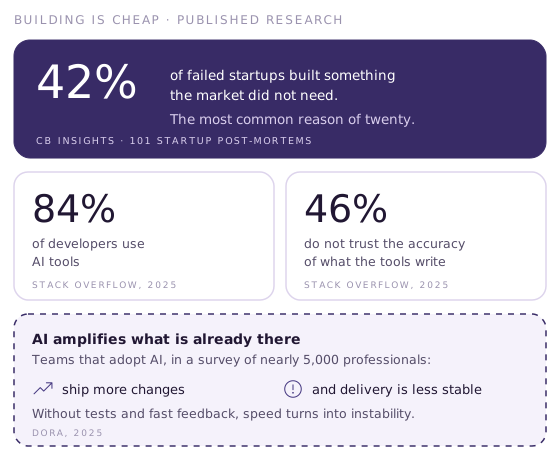
AI tools made code fast and cheap. 84% of developers use them, and 46% do not trust the accuracy of what they write (Stack Overflow, 2025). The tools do not decide what to build, or who gets to see the data.
So the expensive mistake now is a well-built product nobody needed. In a review of 101 failed startups, the most common reason was no market need (CB Insights).
A Fast MVP starts with a DataMind Diagnostic: the hard look first, then the smallest build that can prove the idea.
Signs you need a Fast MVP
Stuck in slides
Leadership or a lender wants to see it work first.
Several ideas, one budget
Which feature, app, or model earns the budget first?
A pilot that stalled
It worked on a clean sample and broke on real data.
How it works
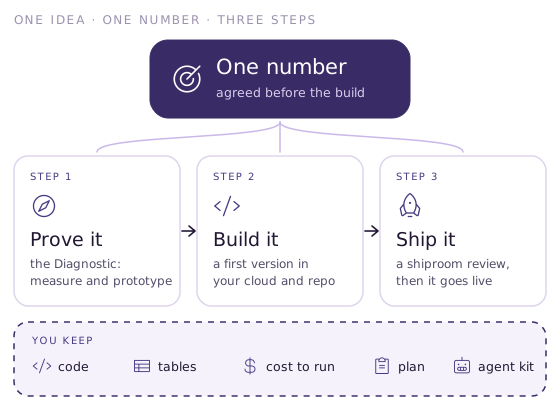
Three steps, each small enough to say yes to.
Prove it
The Diagnostic. We measure where you are, model the options, and build a working prototype on your data. You get a measured cost and a plan in priority order. If you need less than you thought, it says so.
Build it
In your cloud and your repo, with tests and a deploy pipeline. Scored on the number we agreed on. Small enough to replace when the tools change. A live demo every week, on deployment automation from the first commit.
Ship it
A shiproom review before launch: is it ready, what is broken, who owns the fix. Then it goes live, and we report the number to your leadership.
One number, agreed before the build
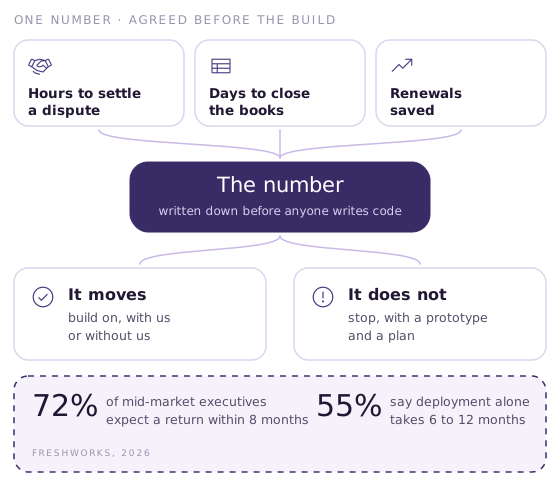
First we name the number the first version must move. Hours to settle a dispute, days to close the books, renewals saved. It is written down before anyone writes code.
Then we build the smallest thing that can move it. For a product, one feature with real users. For a data platform, business-ready tables on your core reporting. Those tables are the first slice of Your Company Brain, and the ones your agents read next.
If the number does not move, you stop with a prototype and a plan. That is the low-risk way to test an idea before a full build.
The shiproom, for your product
Who decides it is ready to ship? We have spent 25 years on hard software problems with the best engineers in the business, in the rooms where that call gets made.
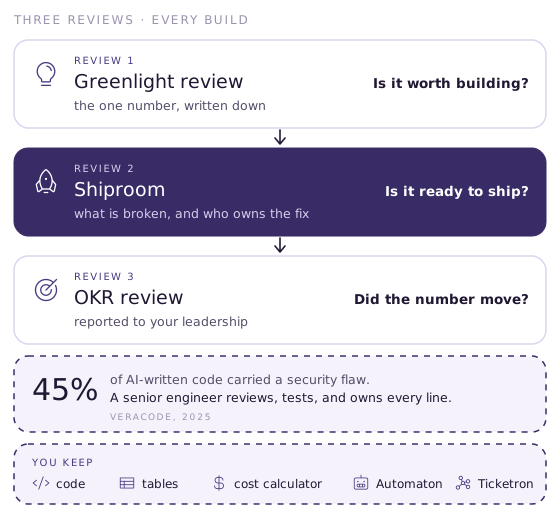
Every Fast MVP goes through three of those rooms. The greenlight review: is it worth building, and what is the one number? The shiproom: is it ready, what is broken, and who owns the fix? The OKR review: did the number move, reported to your leadership in plain terms.
AI coding tools write the first draft. A senior engineer reviews, tests, and owns every line. Access rules are there from the first commit.
You keep all of it: the code, the tables, the cost calculator, and two of our own tools. Automaton is our coding agent kit, so your team keeps building with the AI coding agent of its choice. Ticketron is a graph of your code repo, with our best practices for coding with AI on a small team.
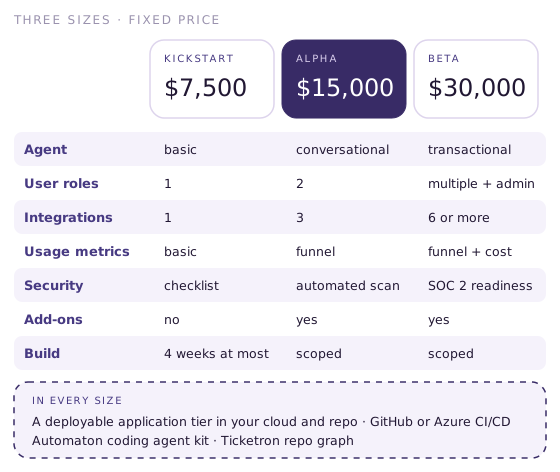
Three sizes, one fixed price each
What does it cost? Each size ships a fully deployable application tier, live in your cloud, with deployment automation on GitHub or Azure.
Kickstart, $7,500: a basic agent that answers from your content, in a build of four weeks at most. It takes no add-ons. If the job needs more, it is an Alpha.
Alpha, $15,000: a conversational agent across your features, checked against a test set.
Beta, $30,000: a transactional agent that books, pays, and updates records under your access rules. SOC 2 controls are built in as we go, so you are ready for the audit once you are live and handling customer data or payments at scale.
A Diagnostic first names what to build and hands over the prototype, and we credit up to $5,000 of its fee toward an Alpha or a Beta. A data lakehouse, machine learning, or marketing optimization is separate work, and can run in parallel.
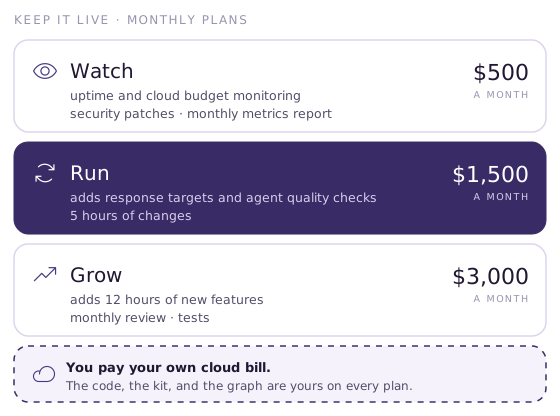
Then we keep it live
You pay your own cloud bill. We keep the service running and report on it.
Watch, $500 a month: uptime and cloud budget monitoring, security patches, and a monthly metrics report.
Run, $1,500 a month: adds response targets, agent quality checks, and five hours of changes.
Grow, $3,000 a month: adds twelve hours of new features, a monthly review, and tests.
The code, the Automaton kit, and the Ticketron graph are yours on every plan, and without one.
Examples
What each size can look like
Kickstart: a front door that answers
A content site with sign-in and visitor capture, and a basic agent that answers from your pages and documents. Example: a property manager's site where a tenant signs in and asks about the lease. Example stack: Azure Static Web Apps, FastAPI, Postgres, GitHub Actions.
Alpha: a portal you can talk to
An account or analytics portal with a conversational agent across its features. Example: a distributor's customers sign in, see orders and invoices, and ask what shipped late last quarter. Example stack adds Azure Container Apps, LangGraph, a search index, and a test set for the agent.
Beta: a simple business, end to end
Site, portal, payments, and a transactional agent. Example: an events company sells tickets to a phone wallet, and the agent rebooks and refunds under access rules, with every action logged. Example stack adds Stripe, wallet passes or a token registry, roles, an audit log, and automated scans.
Shipped at scale, and measured
Our principals are Databricks Certified Data Engineer Professionals. Built Microsoft AI products: PowerPoint Designer and Word Editor. Grew Microsoft Word online and mobile 300% to more than 150M monthly active users in 18 months by pairing analytics and A/B experimentation.
At a national ed-tech provider: an agentic AI platform on Databricks, shipped in 3 months, unifying six legacy products behind one AI interface and data platform.
Automaton, our agent-run SDLC and CI/CD system, built a client's production document product.
Co-inventor, Microsoft patent US 10,839,149 B2: machine learning shipped inside a Microsoft product. MBA, Economics, Entrepreneurship and Technology. MS, Data Science.
We build it, with our network of experts: senior engineers, data scientists and security partners we have worked with for years, brought in when the work needs them.
References
Veracode, 2025 GenAI Code Security Report. 45% of AI-written code carried a security flaw
Bring one idea. Leave knowing if it's worth building.
In a free discovery session we look at the idea, name the number, and say plainly whether it is worth a build. Want the hard look first? The DataMind Diagnostic measures where you are and prototypes one option, for a fixed fee.